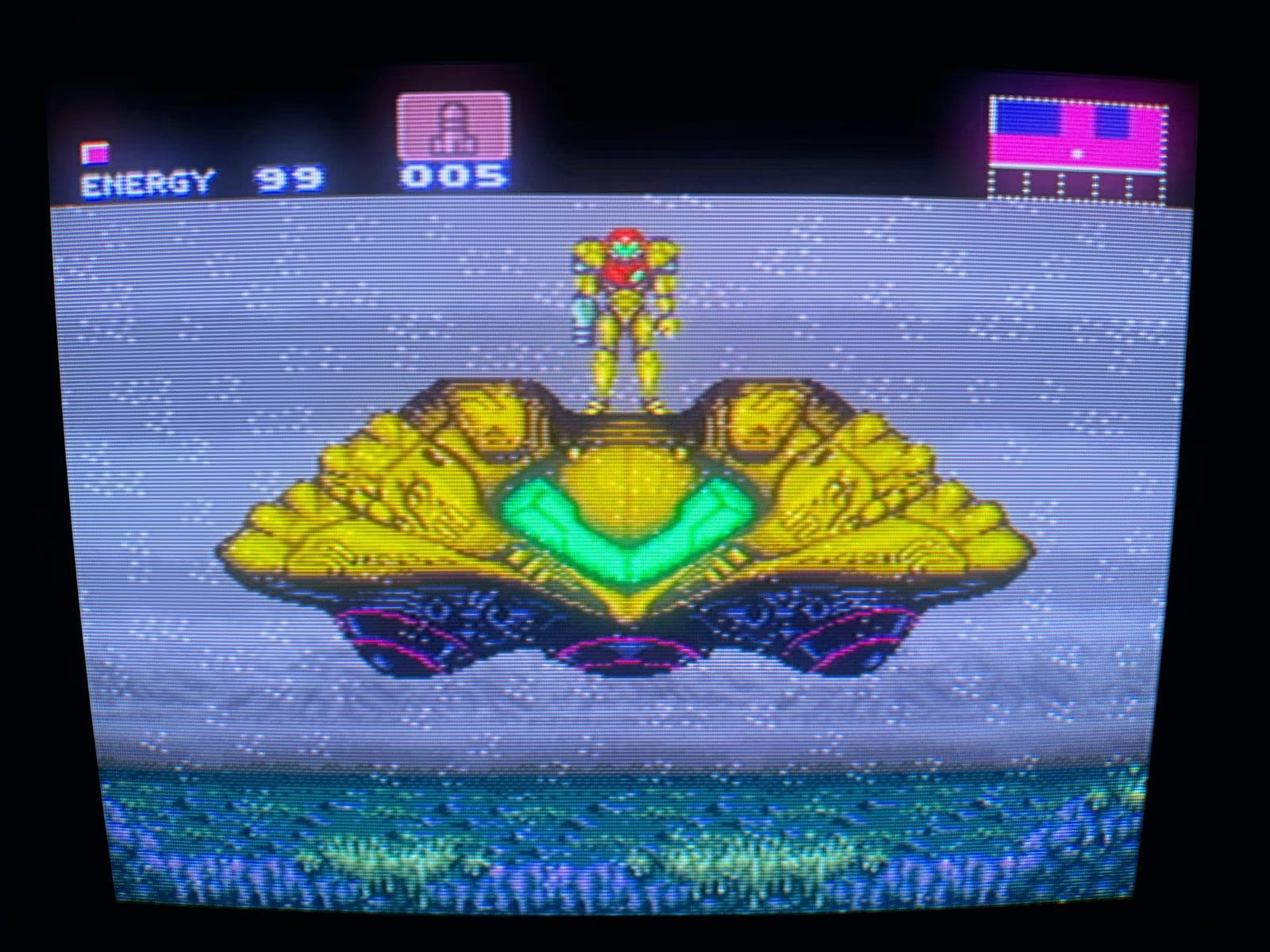
Image: Pixel FX (Super Metroid photographed off a 4K TV running the Morph 4K)
Morph 4K Firmware v4 Adds Composite Signal Simulation, Tate Rotation and a Virtual CRT
Pixel FX released firmware v4 for its Morph 4K video scaler on 21 October, on the device's beta channel. It adds rotation for vertical arcade games, a rebuilt deinterlacer that detects film, new scaling filters including Super-xBR, and a set of features Pixel FX calls Retro FX, which simulate the analog signal path and the CRT a console was originally played on. The same day, Pixel FX reopened pre-orders for the Morph 4K at a higher price of $299.99, with the next batch shipping in the first quarter of 2027.
The announcement is a long post signed by Michael (Woozle), who started Pixel FX. He describes v4 as "the biggest change to the FX-Framework since Pixel FX began", adding that "Nearly every FPGA subsystem has been redesigned, from how pixels are fetched from DDR2 memory to how each one is filtered and placed on screen." Pixel FX says v4 moves to the stable channel once beta testers have worked through it, and has not given a date for that.
What v4 changes
Rotation. The Morph 4K can now turn its input 90 degrees in either direction, for vertical arcade games, TATE-mode ports and MiSTer cores. An Auto Rotation option switches into Tate Mode by itself when a vertical arcade core starts and switches back for a horizontal game. The post calls rotation "fundamentally a memory problem", because reading a frame sideways out of DDR memory is the worst access pattern there is. Pixel FX's answer is a memory layout in which reading a column is as efficient as reading a row, which it says gives full-bandwidth rotation with one frame of latency, for sources up to 720p, custom progressive sources up to 2048x1024, and 1080p when combined with the new downscaler.
The Rational Decimator. That downscaler shrinks the input by any rational ratio, separately on each axis. Pixel FX's example is Mega Man 9 in Mega Man Legacy Collection 2, where the collection scales the picture unevenly so some pixels come out wider than others. The decimator samples it back to the game's original pixel grid, turning a modern re-release into a clean low-resolution signal that the CRT effects can then treat like original hardware.
Deinterlacing. The motion-adaptive deinterlacer was rebuilt, with a Source Noise setting for clean HDMI or noisy analog sources and an edge-following interpolation mode called Edge Smoothing, at Low, Medium or High. A new Film (Auto) mode detects 3:2 cadence (24 frames per second film on DVD) and 2:2 cadence (games rendering at 30 frames per second over 480i) and rebuilds the original full frames. Pixel FX says it locks within about half a second and falls back to motion-adaptive processing when the content changes to true video, and the menu shows whether it has detected 3:2 film, 2:2 film or video. Its demonstration is Final Fantasy X on a PlayStation 2 fitted with Pixel FX's RetroGEM HDMI board, where 2:2 mode recovers the game's 480p frames.
Scaling. New Cubic (Mitchell), Cubic (Catmull-Rom) and Lanczos kernels with an Anti-Ringing control are aimed at 3D, video and PC sources. For pixel art, v4 adds Hyllian's Super-xBR with Pixel FX's own perceptual tuning, alongside xBRZ and Super Eagle. The menus also gain a description box that explains each setting.

Simulating the cable and the television
Retro FX comes in three stages, in the order the picture travelled. Analog Path Simulation takes a clean 240p, 480i or 480p signal, from analog RGB or component or straight from HDMI, re-encodes it as composite or S-Video, optionally passes it through a virtual RF channel, and decodes it as a television would. The RF stage models snow, sound-carrier interference, ghosting and tuning drift. To separate brightness from colour it offers a notch filter, 2-line or 3-line comb filters or an adaptive comb, and the decoder handles PAL with or without the delay line. Pixel FX writes that "Every bandwidth is set in MHz, the same units a TV's service manual uses".
The point for retro players is that dot crawl, rainbows and dither blending come out of the simulated encoding rather than being drawn on top, and each console profile recreates that system's timing between pixels and colour subcarrier. Each artifact is a separate control, and a Blend-only mode keeps the dither blending artists relied on, such as the spotlights in Streets of Rage 2, while removing the rainbows. That matters most for sources that never had a composite look of their own: HDMI-modded consoles and MiSTer.
Beam-to-Glass CRT Simulation covers the tube: Amplifier Blur; three scanline modes, including a new Dynamic mode with energy-conserving beams, an idea Pixel FX credits to Timothy Lottes's CRT shaders; true 480i scanlines that draw each field rather than deinterlacing; convergence, including drift toward the corners; masks with damper wires for aperture grilles; Phosphor Glow; Gamut & White Point presets for US, PAL and Japanese televisions and a Japanese PVM, including a 9300K white point; Curvature that bends scanlines without resampling them; and Tube Sag, which swells the picture on bright scenes as a sagging high-voltage supply did. Michael says the first time he saw that effect recreated was on Marshall H.'s UltraHDMI for the N64.
Bezel & Glass draws a television or cabinet around the picture from a PNG on the SD card, renders the curved edge of the screen opening at full 3840x2160, lights the bezel from the picture, and adds Cabinet Brightness and Room Light controls. Every Morph 4K now includes a virtual 20-inch set built from all of this, the PDM-20.

Four engines on one FPGA
Not everything runs at once. Firmware v4 splits the scaler into four Processing Engines, each reconfiguring the FPGA for one job. Physical Display Model is for 240p and 480i consoles and is the only engine with the full Retro FX chain. Universal Adaptive handles any input, heavy 480i content and 3D, video and PC sources, with the film deinterlacer and a lighter CRT Simulation tier. Spatial Super Resolution is for progressive sources and carries Super-xBR, xBRZ and Super Eagle. Tate Mode handles rotation. A new menu marks the running engine as active and suggests the best one for the detected input, and settings are saved per engine. Each takes inputs up to 1080p, Tate Mode only with the Rational Decimator.
Motion clarity gets Beam Scan, with classic black frame insertion, Rolling Scan (CRT beam simulation) and Bright Strobe (variable persistence), based on algorithms by Mark Rejhon of Blur Busters and Timothy Lottes. These need an output at twice the game's frame rate, 1080p120 for 60Hz games or 1080p100 for 50Hz, and they do not yet run on the Physical Display Model engine. On latency, Pixel FX says the whole chain works as the picture streams through: "The simulation adds lines of delay, not frames."
The Morph 4K and its rivals
Pixel FX announced the Morph 4K in 2023 as a modular scaler: an HDMI-only unit at $275, and a version with an internal Analog Bridge, a pair of analog-to-digital converters with swappable connector cards, at $375. Its June 2026 newsletter added Auto-Sampling, which detects a game's real horizontal resolution as it changes, and opened pre-orders for the smaller Morph 2K at $199.99.
Under the new pricing, the Morph 4K costs $299.99, up from $275, which Pixel FX puts down to rising component costs. The Analog Bridge with a connector card stays at $99.99 and is in stock. A new bundle of a Smoke Black Morph 4K, Analog Bridge and SCART card costs $389.99. Existing back orders keep their original price, and every new unit ships with v4.
The obvious comparison is the RetroTINK-4K Pro, which RetroTINK sells at $750 and which already lists motion-adaptive deinterlacing with 3:2 and 2:2 film modes, rotation for certain resolutions, a composite and S-Video decoder, and CRT-style rolling black frame insertion, with a black frame insertion engine by Blur Busters. Its recent experimental firmware was covered here last week. The Morph 4K's distinguishing claims in v4 are the simulated signal path, Tube Sag, corner convergence and bezel lighting, several of which Pixel FX says have not appeared on an FPGA scaler before. For how FPGA hardware like this works, see the FPGA explainer.
What is not known yet
Pixel FX has not said when v4 reaches the stable channel, or when the Morph 2K and RetroGEM boards will get it; it says they will start with their existing features on the new framework. Mega Bezel support and making custom bezels are promised for a future update, and Beam Scan has yet to reach the Physical Display Model engine. The post also mentions new RetroGEM boards for more consoles and handhelds, the Infinity Switch (which the 2023 Morph 4K page described as "around the corner"), and new Morph 4K expansion cards, with a hint aimed at preservation: "if you're a media preservation fan, you'll want to stay tuned". None of those has a date or price. Pixel FX says it will post a shipping update for pre-orders in January.
Sources
More News

Gaelco's 3D Arcade Board Reaches MiSTer With Speed Up, Surf Planet, Radikal Bikers and Football Power
Developer decoryah released a MiSTer core for Gaelco's late-1990s 3D arcade hardware on 2 November, running all four games of MAME's gaelco3d driver with sound, from the author's own repository.
RetroTINK Firmware Adds Curved CRT Glass, Bezels and Composite Video Simulation
Experimental firmware 1.99.7 to 1.99.10 for the RetroTINK 4K and 6X adds an Advanced CRT Effects page with tube curvature, glass glow and a reflective bezel, plus composite video simulation on the 4K Pro and input and output screenshots.
New 3DO ODE Menu Replaces Fixel's Stock Interface With Box Art, Favourites and Multi-Disc Queueing
Todd Gill has released a free replacement menu for Fixel's FZ-1 ODE, the XPort and SataTo3DO-based clones, built from a byte-exact reconstruction of Fixel's original and designed to make big game folders quick to browse.