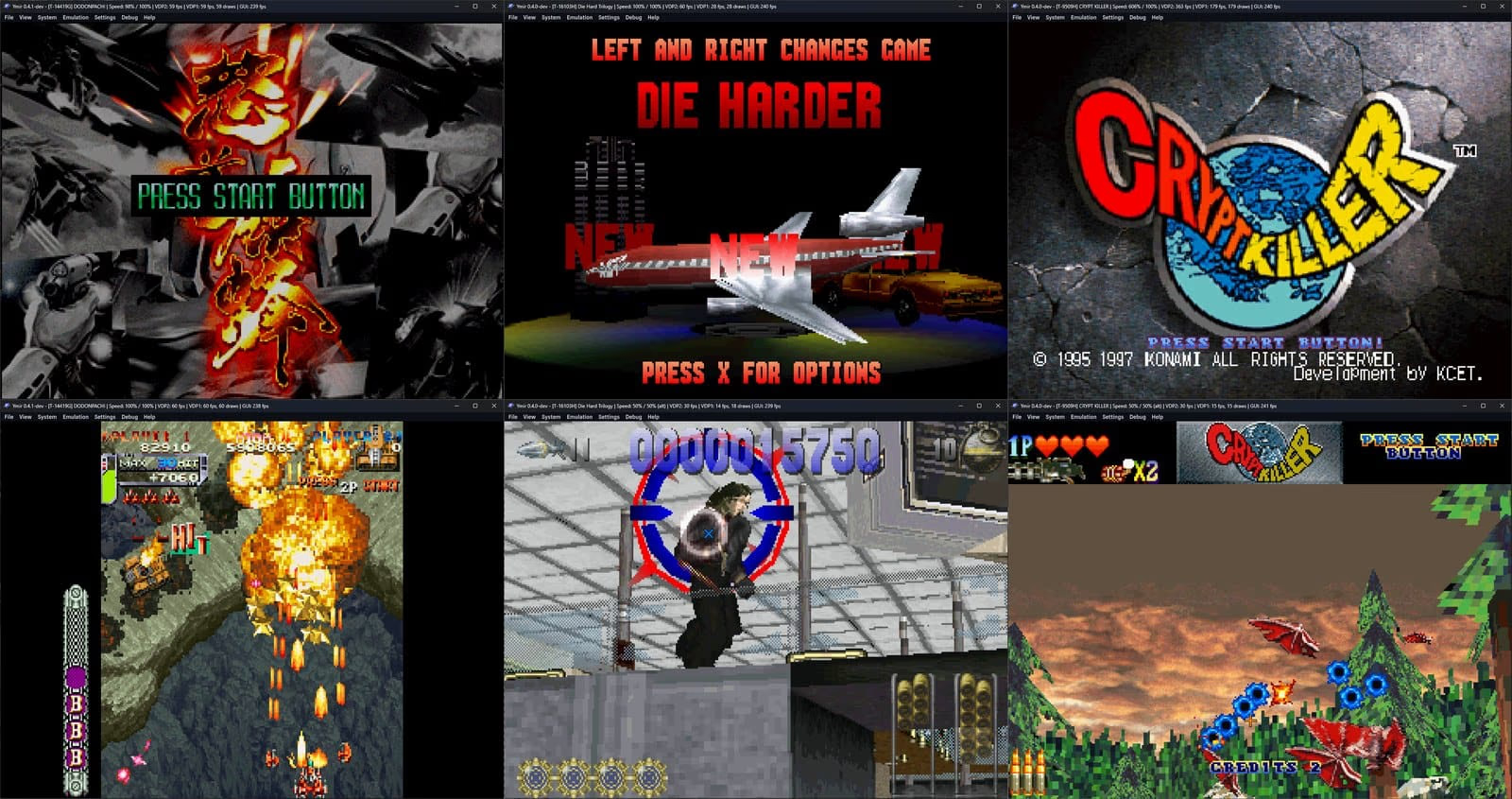
Image: Ymir project, from the v0.4.0 release notes (games running on the Direct3D 12 GPU renderer)
Saturn Emulator Ymir 0.4.0 Adds GPU Rendering and a Stable Virtua Gun
Ymir, the open-source Sega Saturn emulator, reached version 0.4.0 on 17 October with a rebuilt graphics backend that can hand the Saturn's two video chips to a PC's graphics card. On Windows, the new Direct3D 12 renderer moves almost all VDP1 and VDP2 work to the GPU, and the release notes say it is "as accurate as the software renderer, save for undiscovered bugs". A maintenance release, 0.4.1, followed on 18 October to fix a crash on startup on Windows ARM machines, caused by a build issue in Microsoft's DirectX Shader Compiler.
What 0.4.0 changes
Until this release Ymir drew everything through SDL Renderer. Version 0.4.0 replaces that with a new backend supporting Direct3D 12 on Windows, written by StrikerX3, and Metal on macOS, written by SternXD, with SDL Renderer kept as a fallback on systems that support neither. Vulkan, which Wunkolo is working on, and Direct3D 11, which StrikerX3 plans, did not make it in time. The notes explain why the change was needed. An experimental Direct3D 11 branch had been built on top of SDL Renderer, but SDL3's developers plan to phase out modern graphics APIs from it in favour of SDL GPU, which the notes describe as less flexible and powerful than the native APIs, and which would have ended that renderer outright.
GPU-accelerated VDP rendering works only on Direct3D 12 for now. The other backends still need "the necessary plumbing", which the notes say will come in a future release, "hopefully the next one". Title-bar readouts published with the notes show the effect on a development build. Virtua Fighter 2 rises from 417 percent of full speed on the software renderer to 624 percent on the GPU, and from 382 to 617 percent with deinterlacing switched on. Panzer Dragoon Saga, a low-resolution game, goes from 531 to 609 percent with both of Ymir's graphics enhancements active. The notes do not say what PC produced those numbers.

The new backend is also groundwork. According to the notes, native APIs will allow shaders and resolution scaling "down the line". StrikerX3 tried resolution scaling for this version, but architectural decisions made in the past made the work harder than expected, and it was left out rather than delay 0.4.0 further.
Some of the speed gains have nothing to do with the GPU. Running the SCSP, the Saturn's sound processor, on its own thread is up to 10 percent faster after micro-optimisations. A change to SH-2 interrupt handling adds 1 to 3 percent, and VDP1 software renderer optimisations add another 1 to 3 percent.
Virtua Gun, macOS 12 and smaller changes
Sega's Virtua Gun light gun arrived in Ymir 0.3.0 in April, but only in nightly builds, because it worked with a single game, House of the Dead. In 0.4.0 it is a stable feature in all builds. Fixing it took changes to the SMPC (the Saturn's system manager chip), VDP2 and the frontend, and one SMPC bug alone accounted for more than half of the reported problems. Death Crimson, which the notes call "particularly picky", gets a small amount of deliberate jitter in its aim, mimicking inaccurate reads from a real gun, which improves shot detection. Known issues are tracked in issue 787: one game does not register shots, and three do not recognise reloads consistently. A new option keeps the mouse cursor inside the window, so a stray shot cannot hit the close button.
The macOS build now runs on macOS 12 Monterey; version 0.3.3 required macOS 15 Sequoia. According to the notes, the build had been targeting GitHub's default macOS version, which moved to 26 when GitHub upgraded its build runners, and the team lowered the minimum to 12, the lowest the current runner supports.
New contributor surajrbhardwaj added MP3 and OGG audio track support to the CUE loader, a format the notes say homebrew games commonly use. Warmenhoven fixed several CHD read errors, SternXD added Discord Rich Presence, and 4re shrank the embedded font files. MIDI now starts up in the background, which fixes slow launches, and SMPC settings are stored per region so the system language no longer changes when switching between US and Japanese BIOS files. Backup RAM files created by Kronos can now be imported after a strict language check was removed.
Why the Saturn is hard to emulate
The Saturn launched in Japan on 22 November 1994, in North America on 11 May 1995 and in Europe on 8 July 1995, and sold 9.26 million units. It has two Hitachi SH-2 CPUs at 28.6 MHz, a Motorola 68EC000 sound controller and a custom sound processor, an SH-1 that controls the CD drive, a System Control Unit with its own DSP, and two video processors: VDP1 draws sprites and polygons, and VDP2 draws backgrounds. The two SH-2s share a bus and cannot access system memory at the same time, and making full use of each CPU's 4 KB cache was critical to performance. Yu Suzuki, reflecting on the Saturn version of Virtua Fighter, said "only 1 in 100 programmers are good enough to get this kind of speed [double] out of the Saturn". The README of srg320's FPGA Saturn core adds that the console's basic geometric primitive was the quadrilateral, while the rest of the industry built around triangles.
Those details surface in Ymir's notes. Its internal game database now force-enables SH-2 cache emulation for Dino Island, Dragon Force II, Hissatsu! and No-appointment Gals Olympos to fix palette glitches, a black screen and crashes, and forces fast bus timings for Resident Evil to stop crashes in its start menu. Six older game-specific hacks were switched off because accuracy improvements made them unnecessary, including those for Deep Fear and Mega Man X3.
Most of the compatibility gains in this release came from the CD Block and the SMPC, which the notes call "troublemakers". CD Block fixes, helped by test ROMs from celeriyacon, stop Virtual On: Cyber Troopers crashing on match replays and let Gunbird's music resume after a pause. SMPC changes get Fist, Madden NFL 97 and Ten Pin Alley booting and fix crashes in Guardian Heroes. A fix to SCU DMA lets GunBlaze-S boot, which the notes say is the same issue Mednafen encountered.

The chart counts 2,381 titles, 2,377 of them tested. Of those, 2,128 are rated playable and 116 perfect, while 51 show nothing at all. That gives 94.4 percent of tested games, the figure the notes headline.
A young emulator that moves quickly
Ymir's author is StrikerX3, the name on the GitHub account of Ivan Roberto de Oliveira, and the README calls it "A work-in-progress Sega Saturn emulator". The repository was created on 28 April 2025 and v0.1.0 came out on 1 May 2025, with no Mac version. By v0.1.8 in September 2025, Windows ARM and FreeBSD builds had arrived, and StrikerX3 described the CD Block and SMPC as "the Achilles's heel of Ymir's emulation accuracy". Version 0.2.0 in October 2025 added optional low-level CD Block emulation. Version 0.3.2 in June 2026 passed 94 percent compatibility and, through SternXD's work, could move audio processing to another CPU core for up to 25 percent more speed.
Ymir runs on Windows 10 or later, macOS 12 or later, most modern and popular Linux distributions (including a Flatpak) and FreeBSD, on x86-64 and ARM. It needs a Saturn BIOS (IPL) ROM, plus the CD block ROM for low-level CD emulation, and loads CHD, BIN and CUE, IMG and CCD, MDF and MDS, and ISO images. Windows users must install the latest Microsoft Visual C++ Redistributable, which the notes call mandatory, and the macOS build carries an ad-hoc certificate, so macOS flags it as unverified.
How it compares
Mednafen's Saturn documentation calls its emulation "extremely CPU intensive" and recommends at least a quad-core Intel Haswell CPU with a base clock of 3.3 GHz or higher. Ymir's notes claim its own SCSP emulation is "ahead of Mednafen's", a claim from the project rather than an independent test. The two emulators can share saves: since v0.1.5, Ymir has read backup RAM files from Yaba Sanshiro, Mednafen and the Saturn MiSTer core.
On FPGA, srg320's Saturn core for MiSTer needs a 128 MB SDRAM module, and a second module is recommended for better compatibility. The FPGA explainer covers how MiSTer works, and the EmuDeck settings guide covers Saturn emulation on Steam Deck. For games to try, the site has reviews of NiGHTS into Dreams and Sega Rally Championship.
What is not known yet
There is no date for Vulkan, Direct3D 11, or GPU acceleration on Metal. Resolution scaling has no timeline. The notes name the next target plainly: "The weakest parts of emulation right now are SMPC, bus contention and memory access timings." Twenty-seven Japanese games still only boot with a workaround: writing `FF` to address `60FFC13` in the debugger's memory viewer after the black screen, which the notes say may need repeating.
Sources
- Ymir on GitHub: Ymir v0.4.0
- Ymir on GitHub: Ymir v0.4.1
- Ymir on GitHub: Ymir: a Sega Saturn emulator (README)
- Ymir on GitHub: Ymir v0.1.0
- Ymir on GitHub: Ymir v0.1.5
- Ymir on GitHub: Ymir v0.1.8
- Ymir on GitHub: Ymir v0.2.0
- Ymir on GitHub: Ymir v0.3.0
- Ymir on GitHub: Ymir v0.3.2
- Ymir on GitHub: Ymir v0.3.3
- GitHub: StrikerX3 (Ivan Roberto de Oliveira)
- Mednafen: Mednafen Sega Saturn Documentation
- srg320 on GitHub: Sega Saturn Compatible IP Core for FPGA
- Wikipedia: Sega Saturn
More News
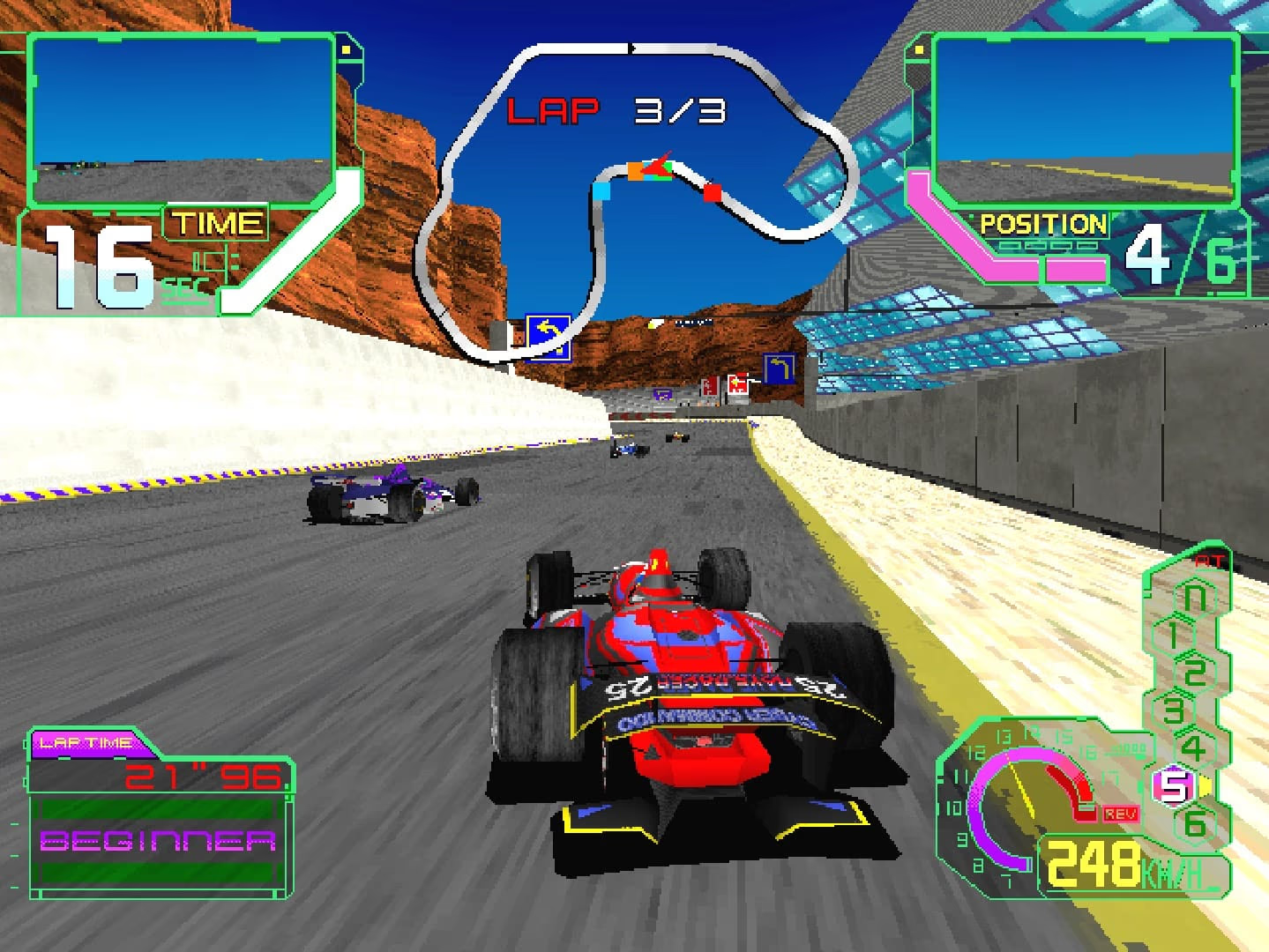
Namco's Ace Driver: Victory Lap Comes Home Through Arcade Archives, With Four Players on Newer Consoles
Hamster is releasing Namco's arcade sequel Ace Driver: Victory Lap on 22 October for Switch, PS4, Switch 2, PS5 and Xbox Series X|S, at $14.99 or $16.99, five months after the original Ace Driver.
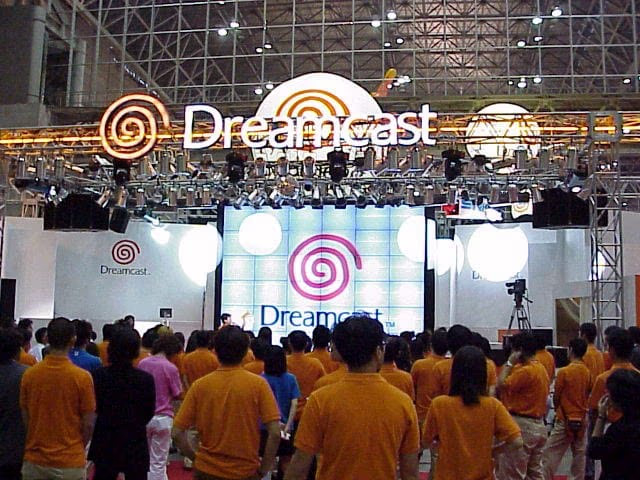
Video Game History Foundation Opens a Photo Archive of Japanese Game Culture From 1999 to 2005
The Colin Williamson photography collection, now free in the VGHF Digital Archive, documents Tokyo Game Show, Nintendo Space World and the streets of Akihabara at the turn of the millennium.
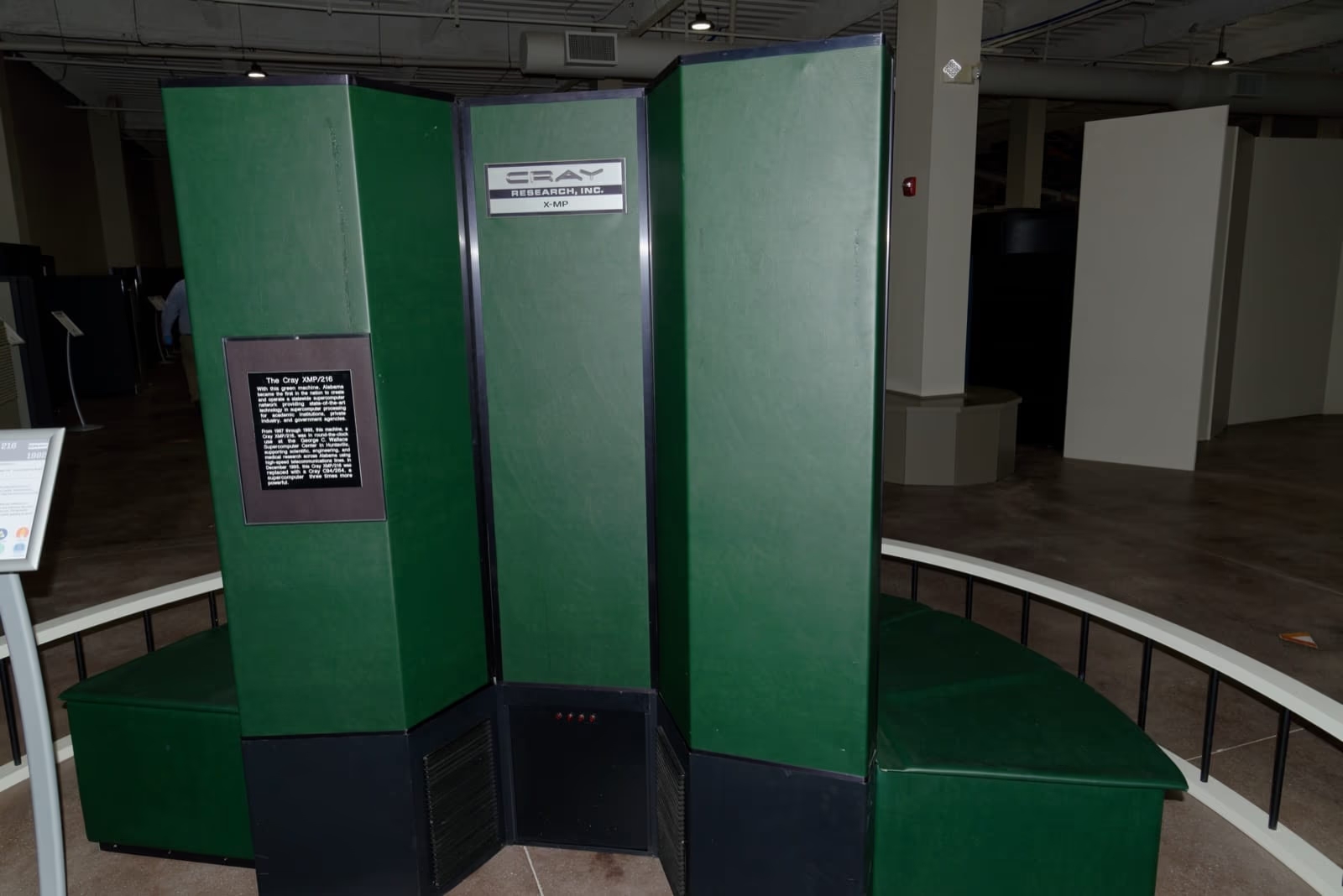
MiSTer Gets a Cray X-MP Core That Boots the Supercomputer's Own Operating System
A new MiSTer core recreates a one-processor Cray X-MP and boots COS 1.17, the only Cray operating system known to survive for the machine. It reached MiSTer's official distribution on 20 October, and a companion project runs Cray Blitz, the 1983 and 1986 world computer chess champion, on it.