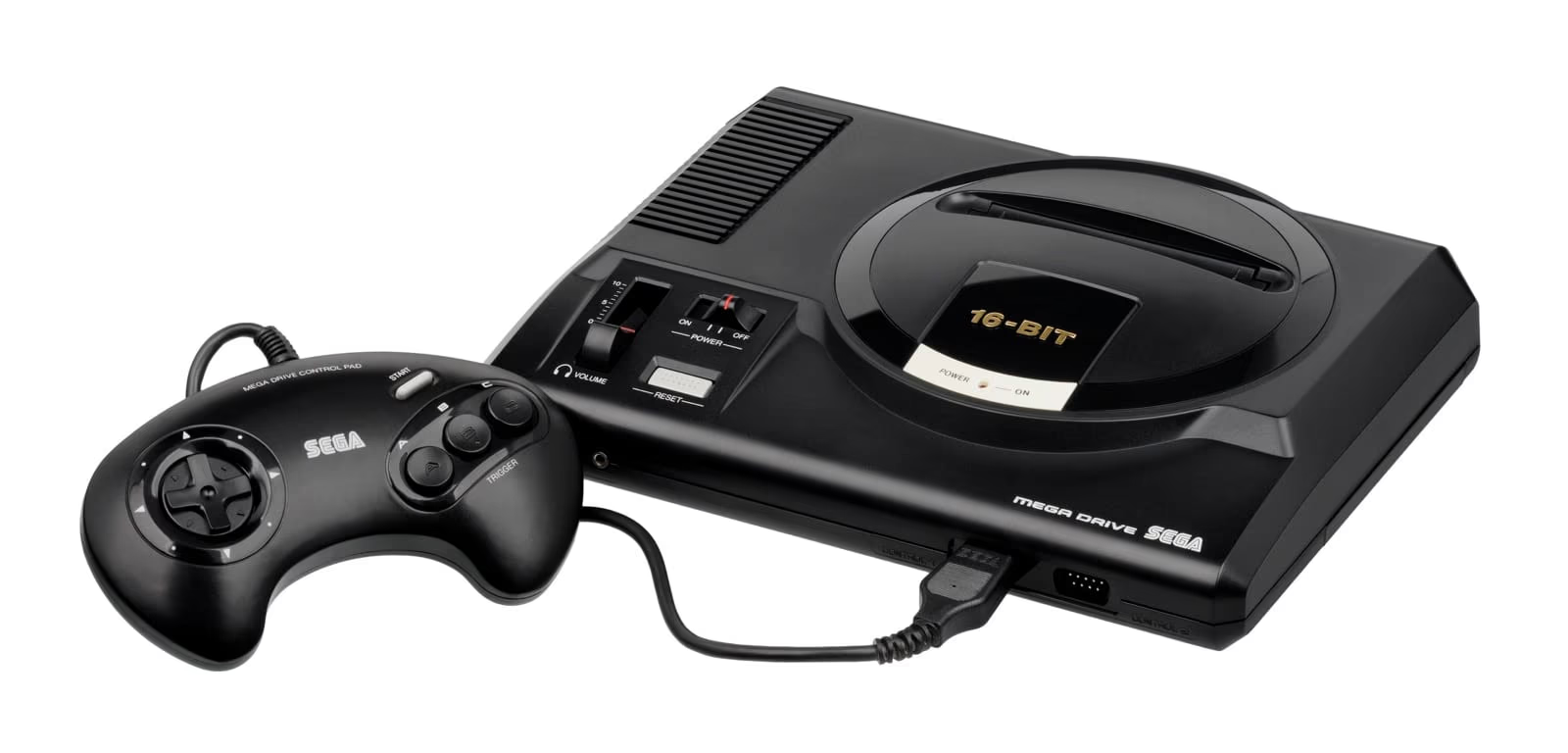
Image: European Sega Mega Drive, photo by Evan-Amos via Wikimedia Commons (public domain)
The Oliver Twins Put Three Dizzy Games on a Mega Drive Cartridge, Three Decades After a Planned Port Never Shipped
Philip and Andrew Oliver, the brothers who created Dizzy, announced The Eggcellent Dizzy Collection on 17 October at Crash Live in Coventry: three Dizzy games, Dizzy the Adventurer, Go! Dizzy Go! and PANIC! Dizzy, on a single cartridge that their press release calls "SEGA Mega Drive compatible". It will be funded on Kickstarter, where a preview page is up but the campaign has not opened. No price, funding goal, campaign date or shipping date has been announced.
The line-up is not new. It is the same trio that made up The Excellent Dizzy Collection, a 1993 Codemasters compilation that came out only on the Game Gear and only in Europe. A Mega Drive version was planned at the time and never released.
What was announced
The twins revealed the collection on stage at noon. Their press release ties it to an anniversary: Dizzy was first published by Codemasters in 1987 and turns 40 in 2027, and the collection is pitched as the start of that anniversary year. It describes the three games in a sentence each. In Dizzy the Adventurer the player sets out to rescue Daisy, Go! Dizzy Go! is a set of arcade challenges, and PANIC! Dizzy tests "thinking and reflexes across three puzzle challenges".
The Kickstarter page, run under the name The Oliver Twins and listed in Warwickshire, is marked "Launching soon" and offers only a button to be notified when the campaign starts. On 20 October it showed 582 followers. Games Asylum, reporting on the day, noted there was no word on stretch goals yet. The press release links a promotional teaser and one gameplay video for each of the three games.
That is everything the twins have confirmed. The release does not say who is manufacturing the cartridge, what packaging comes with it, or which regions it will run in.
The Mega Drive port that never shipped
The history of these three games explains why a Mega Drive cartridge is the point of the project.
Two of the three started life around the Aladdin Deck Enhancer, the ill-fated NES peripheral from Codemasters and its partner Camerica. Dizzy the Adventurer is an enhanced version of Dizzy: Prince of the Yolkfolk, the sixth Dizzy adventure, and was released with the Aladdin in November 1992. Go! Dizzy Go!, an action-puzzle game in which Dizzy is steered through a series of mazes, was also made for the Aladdin; when the device failed it was planned as a stand-alone game for the Master System and Game Gear, and it ended up on the NES only inside the 1992 compilation Quattro Arcade. PANIC! Dizzy was first released as a stand-alone puzzle game for the Amstrad CPC, ZX Spectrum and Commodore 64, in which the player slides a wall left and right so that falling shapes drop through holes of the same shape. It was designed by the twins and developed by Big Red Software.

According to Wikipedia's account of the compilation, Codemasters did not want to sell the twins' games separately at full price after the Aladdin failed, so it asked for a compilation instead. The first plan was Go! Dizzy Go!, Dizzy the Adventurer and Wonderland Dizzy, but Codemasters' marketing team would not put two adventure games on one cartridge, so Wonderland Dizzy was dropped and PANIC! Dizzy took its place. The result came out on the Game Gear in November 1993. Ports for the Master System and Mega Drive were slated for January 1994, according to Mega Power magazine at the time, and neither appeared.
The Mega Drive versions were not just plans. Games That Weren't, the preservation site for cancelled software, says two Dizzy games were made for the Mega Drive and never released: Dizzy the Adventurer and Panic! Dizzy. The only Dizzy game that did come out on the console was Fantastic Dizzy. The fan site Yolkfolk.com was given original cartridges of Dizzy the Adventurer by the Oliver Twins and posted a 13-minute gameplay video, but could not back up the ROM and returned the cartridges. It also posted footage of the Mega Drive Panic! Dizzy, which Games That Weren't says looks fully finished, but that prototype was never archived either. Games That Weren't's page on them was last updated in May 2026 and still describes both as unarchived.
The twins' announcement does not say whether the new cartridge uses those early 1990s Mega Drive builds or new conversions. The Kickstarter page says only this: "The gameplay shown comes from the original coded games, now being brought to the Mega Drive."
Why Dizzy went quiet
After the compilation the Olivers fell out with Codemasters and stopped working with the company. The rights to the series were split, with the twins holding the copyright and Codemasters the trademark, which in practice ended the series for years. The twins had founded Interactive Studios in 1990, later renamed Blitz Games Studios; it closed in 2013 with the loss of 175 staff.
Dizzy has come back in fragments since. In 2015 Philip Oliver found the source code for Wonderland Dizzy, the game cut from the 1993 compilation, and it was released free online on 24 October 2015. A remake of Fantasy World Dizzy for the NES, Mystery World Dizzy, followed on 8 April 2017, and Dreamworld Pogie, the Aladdin-era spin-off starring Dizzy's pet, was released after a Kickstarter in 2017. The Kickstarter statement for the new collection links the long gap to the same causes: "Restrictions around the Dizzy IP, along with the cost of developing games after Blitz Games closed, kept us from working on Dizzy the way we wanted for many years."
How AI was and was not used
The twins describe AI-assisted coding as part of their wider development work, and the Kickstarter page addresses the subject directly in a section titled "Use of AI". On the games themselves it is unambiguous: "AI was not used to create the games in this Kickstarter." It adds that the screens shown are "genuine gameplay, not AI-generated images".
The artwork is a different matter. The same statement says: "We used AI tools in a limited capacity to help our developers and illustrators with the cover artwork and supporting visuals, while staying faithful to the original games." It also points to future "Dizzy Ultra projects" and says the twins will "be open about the tools we use". For that reason Cart & Pixel has not used the collection's cover art or campaign artwork with this story.
What is not known yet
The campaign has no start date, and the page lists no price, reward tiers or funding target. The twins have not said when the cartridge will ship, who is producing it, whether it is region free, or whether it comes boxed with a manual. They have also not said whether the cartridge is built from the unreleased 1994 Mega Drive code that Games That Weren't documented or from new conversions of the Game Gear and NES versions, and whether any of the three games has been changed.
For anyone who wants the Game Gear context while waiting, the Sonic the Hedgehog (Game Gear) review covers the handheld the original compilation ran on.
Sources
- The Oliver Twins, via Games Press: Dizzy is back! The Oliver Twins reveal The Eggcellent Dizzy Collection at Crash Live in Coventry
- The Oliver Twins on Kickstarter: The Eggcellent Dizzy Collection
- Games Asylum: A Kickstarter is planned for a new Dizzy collection on Mega Drive
- Indie Retro News: The Eggcellent Dizzy Collection: Three Dizzy classics are coming to the Sega Mega Drive
- Games That Weren't: Unreleased Dizzy games on the Megadrive: So close yet so far?
- Wikipedia: The Excellent Dizzy Collection
- Wikipedia: Dizzy (series)
- Wikipedia: Dizzy: Prince of the Yolkfolk
- Wikipedia: Dizzy Panic
- Wikipedia: Oliver Twins
More News
Namco's Ace Driver: Victory Lap Comes Home Through Arcade Archives, With Four Players on Newer Consoles
Hamster is releasing Namco's arcade sequel Ace Driver: Victory Lap on 22 October for Switch, PS4, Switch 2, PS5 and Xbox Series X|S, at $14.99 or $16.99, five months after the original Ace Driver.
Video Game History Foundation Opens a Photo Archive of Japanese Game Culture From 1999 to 2005
The Colin Williamson photography collection, now free in the VGHF Digital Archive, documents Tokyo Game Show, Nintendo Space World and the streets of Akihabara at the turn of the millennium.
MiSTer Gets a Cray X-MP Core That Boots the Supercomputer's Own Operating System
A new MiSTer core recreates a one-processor Cray X-MP and boots COS 1.17, the only Cray operating system known to survive for the machine. It reached MiSTer's official distribution on 20 October, and a companion project runs Cray Blitz, the 1983 and 1986 world computer chess champion, on it.