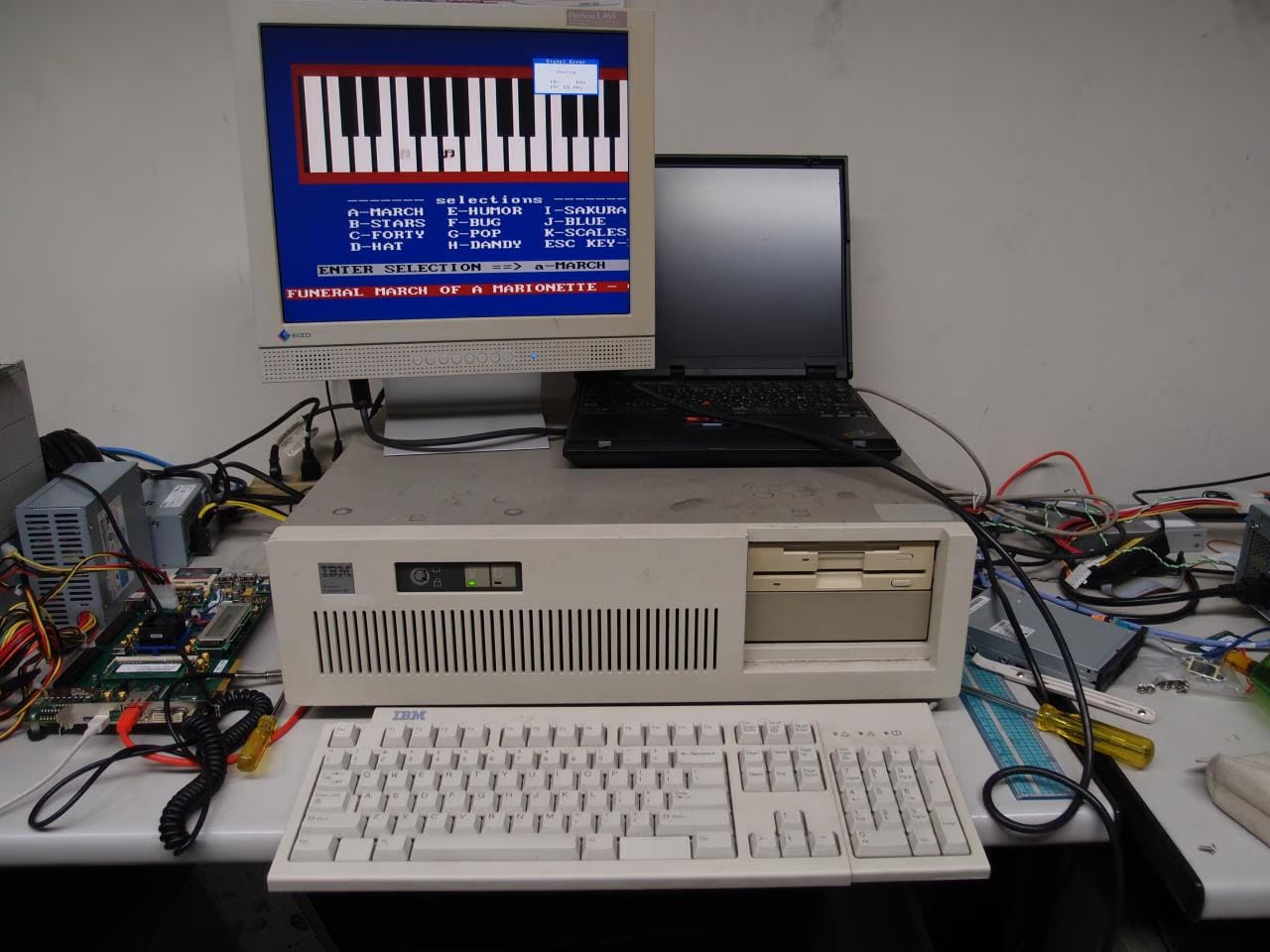
Image: IBM 5170 (PC/AT) running EGA graphics, photo by okqubit.net (public domain, Wikimedia Commons)
MiSTer Gets a 286 PC/AT Core, Built on a New 80286 CPU Written With AI Agents
MiSTer has a new IBM PC/AT core built around a 286. PCAT-286, by Aitor Gómez García (spark2k06), was published to the official MiSTer-devel organisation on 18 October 2026, after several public betas. It recreates an 80286 machine with the AT chipset, EGA graphics, up to 16 MiB of RAM and period sound cards, which puts it between the existing PC/XT and 486 cores. Its processor is new too: a 286 that its author says was written with AI coding agents and verified against captures from real chips.
What the core includes
The README lists the full AT motherboard: two interrupt controllers and two DMA controllers, the timer, the 8042 keyboard controller (which also handles the A20 address line), and the battery-backed clock and CMOS settings. Storage is floppy images (IMG, IMA and VFD) and VHD hard disk images on an IDE interface. The MiSTer mouse appears to DOS as a serial mouse on COM1.
RAM is selectable at 1, 2, 4, 8 or 16 MiB, with 4 MiB the default. The supplied build keeps that memory in the DE10-Nano's own DDR3, so no SDRAM add-on board is needed; a build without that option uses the SDRAM module instead. There is also 96 KiB of upper memory and 2 MiB of EMS for DOS memory managers to use.
Sound covers most of what a 286 owner could have fitted: Sound Blaster, an OPL2 (AdLib) FM chip, Creative Music System, Tandy sound and MPU-401 MIDI, with support for an external MT32-pi. A small DOS utility, `AT286CTL`, can switch sound and joystick settings per game from a batch file.
Video is EGA, with an option to switch the monitor type between an EGA display, a CGA display and a monochrome one. A DOS program, `VGATSR.COM`, turns on a limited VGA extension covering mode 13h (320 by 200 in 256 colours) and several unchained modes, and the README documents specific handling for Pinball Fantasies and Dyna Blaster. Native EGA output runs at about 15.7 kHz in 200-line modes, which suits a television CRT; 350-line modes can be converted to 480i or 240p for the same purpose.
`CPU Speed` in the menu selects MAX or fixed profiles of 6, 8, 10, 12.5, 16, 20 or 25 MHz, and changes take effect without a reboot. The author is careful about what those numbers mean: the README says the labels "do not certify native 286 pin timing, internal overlap or every instruction's historical duration".

No BIOS is included. The tested system BIOSes are PhoenixBIOS A286 1.01 and MR BIOS V1.65, and the core also needs IBM's EGA BIOS. A browser-based BIOS Builder on the project's site fetches reference images from the 86Box ROM archive and minuszerodegrees.net and prepares both files; nothing is uploaded.
The machine it recreates
IBM released the Personal Computer AT, model 5170, in August 1984. It was the first IBM PC built on the 16-bit Intel 80286 rather than the 8088, and sold for about US$6,000. In April 1986 IBM raised its clock from 6 to 8 MHz. The AT's 16-bit expansion bus later became known as ISA, and its 24-bit address bus took memory up to 16 MB. It also introduced the battery-backed clock with CMOS settings and the 1.2 MB floppy drive. IBM discontinued it in 1987.
On the project's forum thread, a beta tester reported trying about 110 DOS games on the first beta, with Monkey Island 1 and 2 in VGA, Indiana Jones 3 and 4, King's Quest IV and V, Civilization, Wing Commander, Ultima VI and Red Baron among those that ran fine.
A 286 written with AI coding agents
The core's processor is SPK286, a separate MIT-licensed project that Gómez García published on GitHub in September. Its README says real mode covers every documented 80286 instruction, checked against the SingleStepTests/80286 corpus of captures from real hardware for all 307 real-mode opcode forms. Protected mode covers descriptors, privilege checks, gates, task switching and double faults, and the undocumented LOADALL and SALC instructions are implemented. Cycle accuracy is not claimed, and there is no 80287 maths coprocessor.
The SPK286 README is direct about how it was made: "Its RTL, microcode, tools and tests were written with AI coding agents." The author, it continues, set the architecture and scope, defined the verification strategy and ran the testing, and "Correctness rests on that verification". On the forum, when MicroCoreLabs, the author of the MCL86 CPU core, asked whether the core was AI-written, Gómez García said that writing the CPU by hand "would have been beyond my reach", and described the developer's own part as "deciding what to build, how to verify it, and many hours of testing until it worked". MicroCoreLabs replied that the work was excellent. On 15 October Gómez García reported that the full SingleStepTests/80286 corpus, about 1.4 million cases, still passed after a round of speed work.
The betas show how fast it moved. The first post, on 13 September, was a "first look" with CheckIt reporting 2,368 Dhrystones. BETA 03 on 3 October substantially improved protected mode, got Windows 3.1 and OS/2 1.3 to their desktops on real MiSTer hardware, and lifted CheckIt to 6,765 Dhrystones. BETA 04 on 6 October added the speed profiles and fixed floppy writes, and a build using the DDR3 memory followed on 14 October.
Where it fits on MiSTer
Gómez García is the developer behind the MiSTer PC/XT core, which uses the MCL86 CPU and the KFPC-XT chipset, and PCAT-286's machine was built from the PCXT-EGA core. At the other end, the ao486 core offers 486SX33-class performance, 256 MB of RAM and SVGA. PCAT-286 fills the gap between them. Asked on the forum about a VGA version, Gómez García said a complete VGA card would make more sense in a 386 or later core, and that z386, z486 and ao486 "already do that very well". In September Gómez García described the aim as preserving "the original machine's performance and feel".
The FPGA explainer covers how MiSTer cores like this one work.
What is not known yet
Support in the official Main_MiSTer program is still pending: pull request #1367 was opened on 18 October, and until it is merged the core needs the Main_MiSTer build from the forum thread. As of 19 October it is not in the computer folder of the MiSTer distribution, so the standard update scripts do not install it yet. The README lists open items plainly, including some DMA, clock and interrupt controller behaviour that has not been independently checked, protected-mode edge cases, and the fact that the fixed speed profiles are provisional. Asked whether the core is cycle accurate, Gómez García answered: "Not yet, to be honest."
Sources
- MiSTer-devel on GitHub: PCAT-286_MiSTer
- MiSTer FPGA Forum: [PCAT-286] A new 80286 AT core for MiSTer FPGA
- MiSTer-devel on GitHub: Add PCAT-286 core support (#1367)
- spark2k06 on GitHub: SPK286: Synthesizable Intel 80286-compatible CPU core
- MiSTer-devel on GitHub: PCXT_MiSTer: IBM PC/XT for MiSTer FPGA
- MiSTer-devel on GitHub: ao486_MiSTer
- MiSTer-devel on GitHub: Distribution_MiSTer: _Computer folder
- Wikipedia: IBM Personal Computer/AT
More News
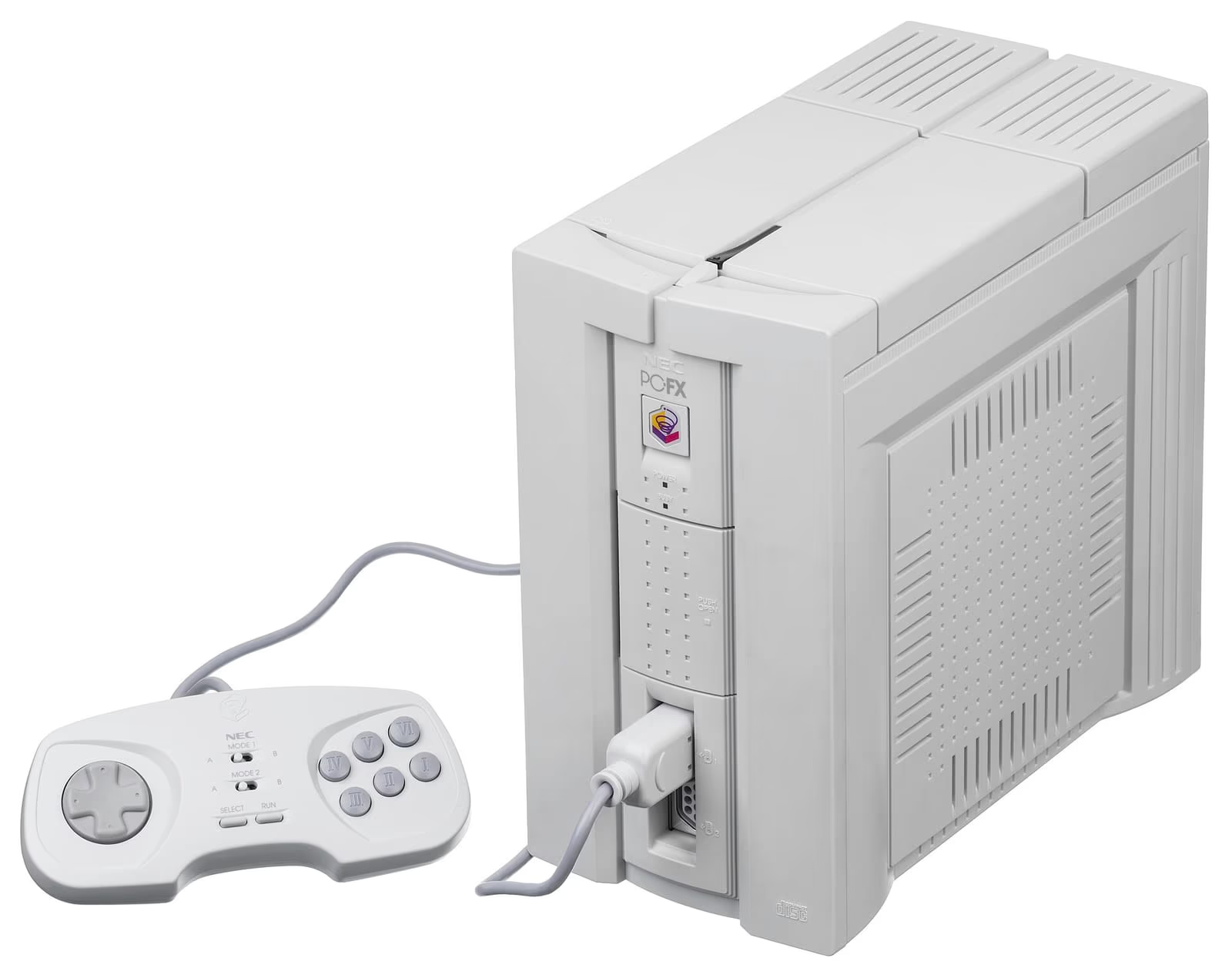
Kitrinx Releases a PC-FX Core for MiSTer That Aims to Run the Whole Library
Jamie Blanks (Kitrinx) published a NEC PC-FX core to the official MiSTer-devel organisation on 18 October, a day after the matching CD and memory card support was merged into the MiSTer main binary. It is the second PC-FX core in the project, alongside David Hunter's work in progress.
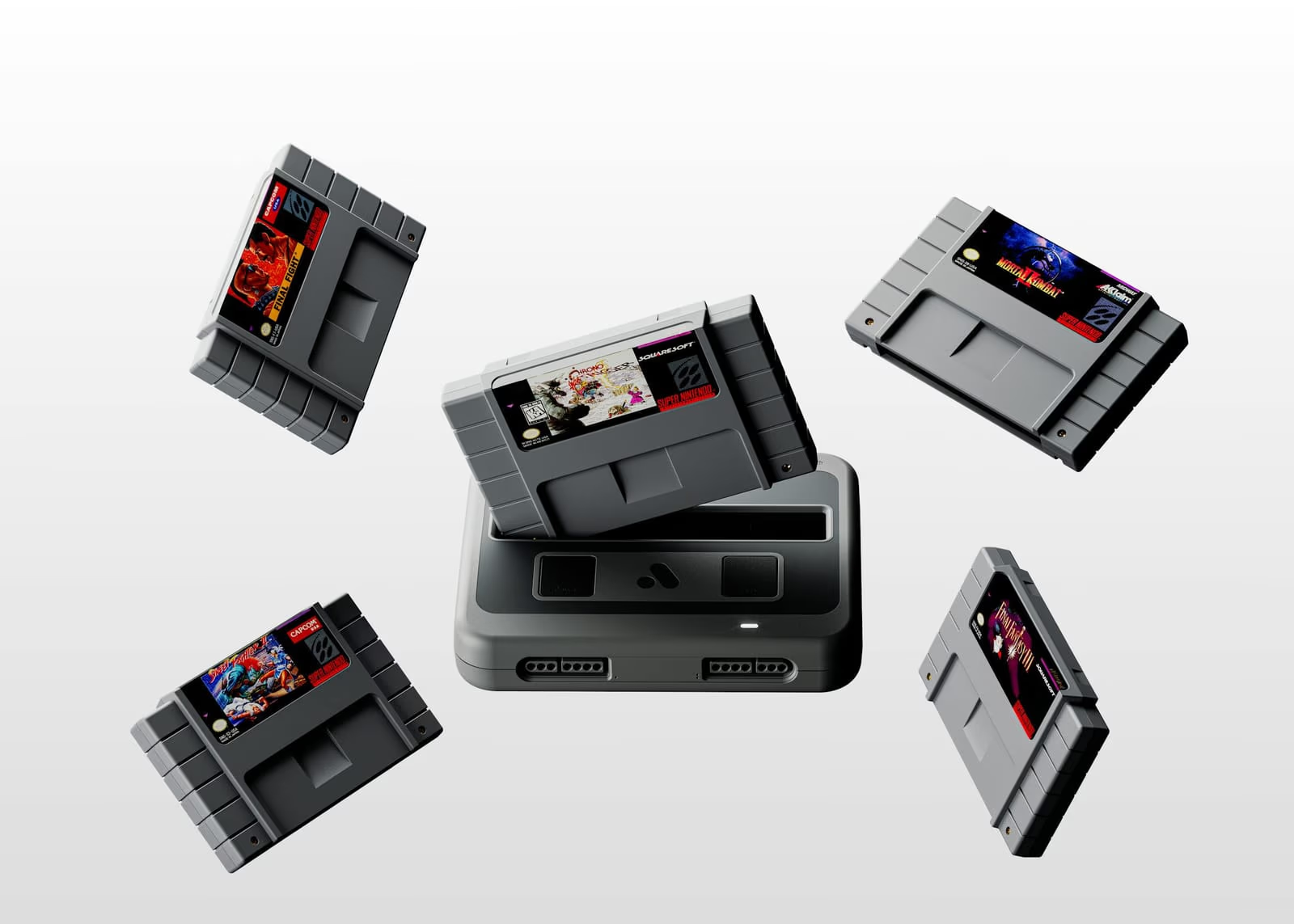
Analogue Announces Super Nt+ and Mega Sg+, With Wireless Controllers and USB-C, for $219.99
Analogue's FPGA Super Nintendo and Mega Drive consoles return as the Super Nt+ and Mega Sg+, adding Bluetooth and 2.4 GHz controllers, USB-C power and hot-swappable cartridges. Preorders open on 19 October at 8am PDT, and both ship in December.
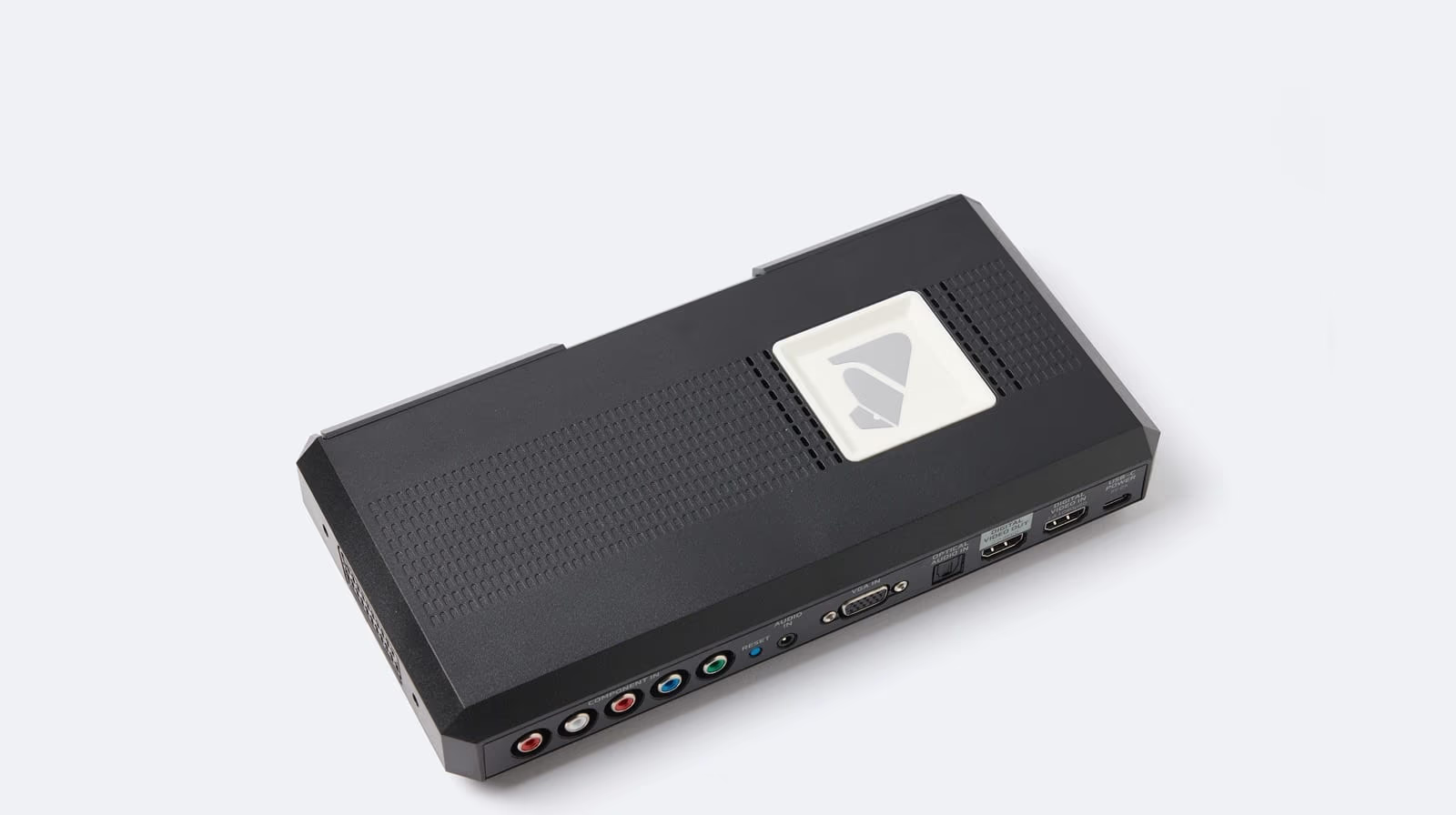
RetroTINK 4K Firmware 1.99 Brings Its CRT Beam Simulation in Line With Blur Busters' Reference Shader
Experimental firmware 1.99.0 and 1.99.1 for the RetroTINK 4K add a Multi-frame Glow option and a Motion Clarity control that match the open-source CRT beam simulator by Blur Busters and Timothy Lottes, capping a month of builds that also brought true VRR, a new inverse telecine engine and steadier Lumacode.