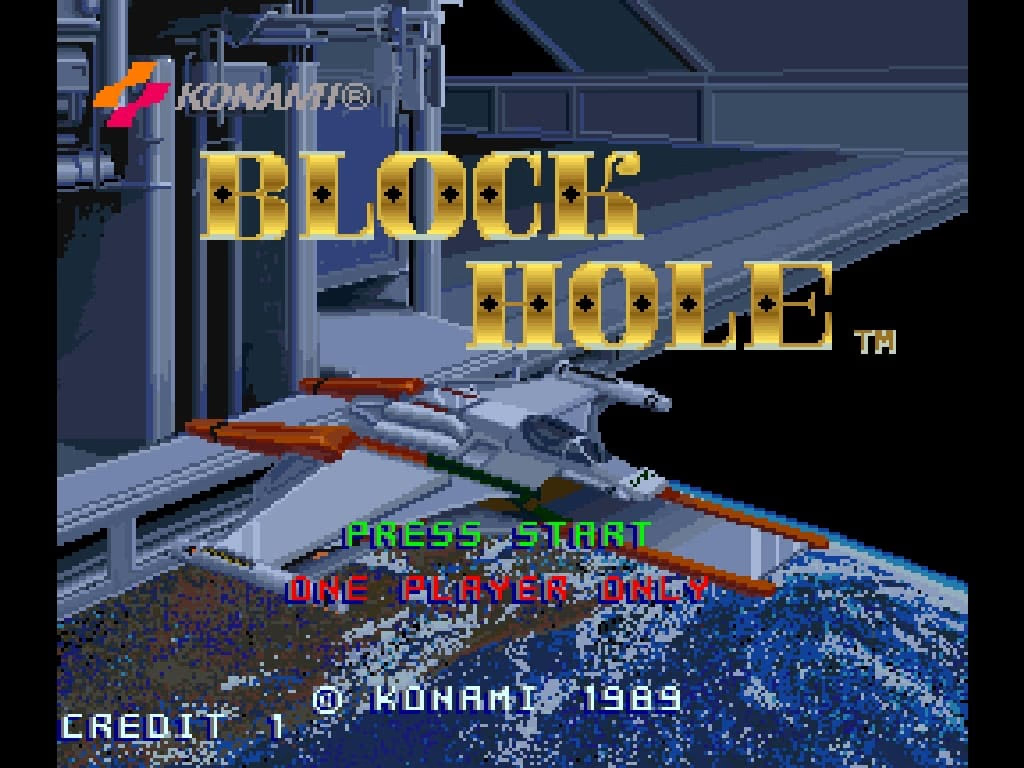
Image: Block Hole title screen as drawn by the core in simulation, from the Arcade-BlockHole_MiSTer repository. Block Hole © Konami 1989
Konami's Block Hole and Quarth Arrive on MiSTer in a Core Checked Frame by Frame Against MAME
Konami's 1989 arcade puzzle game Block Hole, released in Japan as Quarth, now runs on MiSTer. A developer who publishes as decoryah put the core on GitHub on 29 October, tagged release 20261029, and it plays both the international Block Hole and the Japanese Quarth from a standard MAME romset. The core is not part of the official MiSTer-devel collection; it is distributed from the author's own repository and update database.
What the core does
According to its README, the core recreates the whole board: "a Konami 052526 CPU, the K052109 / K051962 tilemaps, the K051960 / K051937 sprites with zoom and shadows, and a Z80 with a YM2151 for sound." It was written from MAME 0.289's Block Hole driver, and MAME is the reference for every comparison the author made. The CPU, the sound chip and the Konami video chips are not new work: they are jotego's open source implementations (jtkcpu, jt51 and his Konami video modules), which the README notes were built "from furrtek's die-shot work".
All of the game's ROMs fit in the FPGA's own block RAM, so no SDRAM board is needed. The release report says the design uses 32 percent of the chip's logic and meets timing in Quartus 17.0.2.
Installation is manual or through MiSTer's Downloader. The release zip goes over the root of the SD card and puts `Block Hole.mra` in the Arcade menu and Quarth's MRA under `_alternatives`. Players supply their own MAME 0.289 `blockhl.zip`; the merged set covers both games, while a split set also needs `quarth.zip`. To get updates automatically, the author's database can be added to Downloader as `[decoryah/MiSTer_decoryah]`, which installs the files under `_Arcade/_Decoryah/_BlockHole`. Anyone with an older `blockhl_*.rbf` file is told to delete it so the MRA cannot start the wrong one.
The controls are a joystick and one button per player. MAME lists three buttons, but the author tested all three in MAME and found the game reads them identically, so the core's single Shoot button drives all three. The on-screen menu has MAME's DIP switches (coinage, lives, difficulty, demo sounds, flip screen, service mode), integer scaling, HQ2x and CRT scanline effects, and a volume control. There is also a CRT Adjust page, rmonic79's module for 15 kHz analogue output, which moves and resizes the picture through a line buffer while keeping the sync timing steady so a CRT stays locked.
The video timing matches the original board: a 6 MHz dot clock, 15.625 kHz horizontal and 59.19 Hz vertical, with a visible picture of 288 by 224.
How it was tested
The README is open about what has and has not been checked. Only one test build, dated 28 October, has run on a real MiSTer, by the author; the published release differs from it only by dropping a screen width option. Everything else was checked in simulation, with the whole machine running the game's program and its frames compared to MAME's.
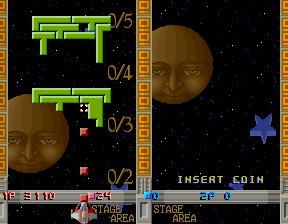
On that comparison the RAM and ROM check screen matches MAME "pixel for pixel", as does the title screen with its zoomed asteroids. The core reaches the title 39 frames earlier than MAME, because jotego's CPU uses instruction timings measured on a real Konami processor while MAME counts standard 6809 cycles. Once that offset is allowed for, the first frames of a game also match. After that the blocks the game deals differ from MAME's run, which the author attributes most likely to the game drawing its random numbers from a count since power-on. The README adds that a real board would follow its own CPU timing, so "neither the core nor MAME is the reference for this."
Sprites needed the most work. jotego's sprite chip zoomed differently from MAME, so the author changed it to scale the way MAME does. On the title frame used as the test, 5,979 pixels differed with the original zoom and none once both changes were in. Sound was compared against a MAME recording of the same play: the level is within 1 to 2 percent of MAME's.
Two gaps are listed. The watchdog timer is not modelled, and the power-on timing difference means the logo's colour cycle on the coin screen is one step out from MAME's.
The game
Block Hole came out in Japanese arcades on 9 October 1989. It crosses falling-block puzzles with a fixed shooter: a ship at the bottom of the screen fires blocks upward to complete squares and rectangles, which then clear, with bigger shapes scoring more. The blocks come faster and more often as the levels go on, and the game ends when they reach the dotted line at the bottom of the screen. The music is by Norio Hanzawa. The arcade game supports two players.
Konami ported Quarth to the MSX2 (9 March 1990), the Game Boy (16 March 1990 in Japan, December 1990 in North America) and the Famicom (13 April 1990). The European Game Boy Color release of Konami GB Collection Vol. 2 renamed it Block Game.
The board's processor, the 052526, is described in the core's hardware notes as "a 6809 with Konami's extra instructions", running at 24 MHz divided by two. jotego's jtkcpu, which the core uses, takes its instruction timing from measurements of real 052001 and 052526 chips, according to the core's notes. RetroRGB reported in April 2023 that jotego had named Block Hole as another game his Konami CPU core could support.
Who is behind it
decoryah's GitHub account lists 25 repositories, all created in October 2026, most of them arcade cores. They include Konami's Hexion, Mystic Warriors, Violent Storm, Metamorphic Force, Monster Maulers and Gaiapolis, as well as cores for the Taito L System, Metro, Seta 2 and IGS PGM2 boards, Gunpey and others. The README says Block Hole reuses the fast loading, standby screen and CRT Adjust code from the author's Hexion and Rabbit cores. The release credits MAME's Block Hole driver to Nicola Salmoria, the tv80 Z80 to Guy Hutchison, CRT Adjust to rmonic79 (Umberto Parisi) with Andrea Bogazzi, and the MiSTer framework to Sorgelig and its contributors.
Other ways to play
Hamster released the arcade game in its Arcade Archives series for Switch and PS4 in January 2021; Destructoid put the price at around $8. The Game Boy version was on the Nintendo 3DS Virtual Console, the MSX version on the Wii and Wii U Virtual Consoles, and Hamster's earlier Oretachi Gēsen Zoku series released an emulated PS2 version in 2006. On PC, MAME emulates the board, and its 0.289 driver is what this core was built against. For readers new to the platform, the FPGA explainer covers how MiSTer recreates hardware.
What is not known yet
The core has had one release and one commit. Only the author has run it on real hardware, and there is no release thread or wider testing report yet, so how it behaves across different MiSTer setups and displays is still to be seen. It is not in the MiSTer-devel repositories, and nothing says whether it will be submitted there. The difference in random block sequences from MAME is explained by CPU timing in the README, but the author notes that only a real board could settle which is correct.
Sources
- decoryah on GitHub: Arcade-BlockHole_MiSTer
- decoryah on GitHub: BlockHole_MiSTer_20261029
- decoryah on GitHub: Block Hole hardware notes
- decoryah on GitHub: MiSTer_decoryah downloader database
- GitHub: decoryah's repositories
- RetroRGB: MiSTer FPGA News: Jaleco Mega System 1, TMNT & More
- Destructoid: Konami's unique Quarth joins the Arcade Archives as Block Hole
- Wikipedia: Block Hole
More News
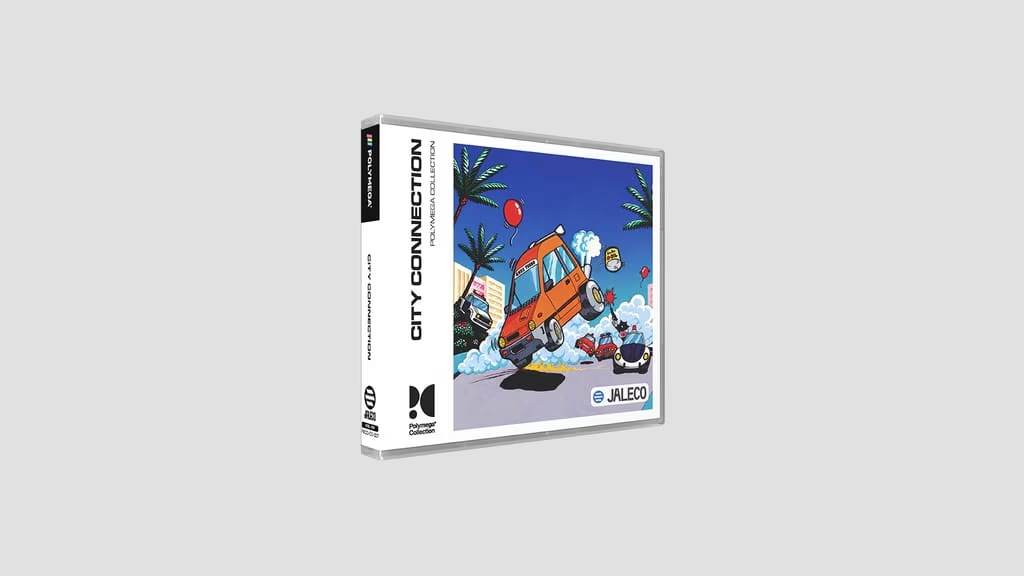
Polymega Collection Vol. 23 Puts Seven Jaleco Games on One Disc, Including Scud Hammer and Game Tengoku
Polymega has opened preorders for Collection Vol. 23, City Connection: a $39.99 disc of seven Jaleco arcade and console games, shipping in November 2026.
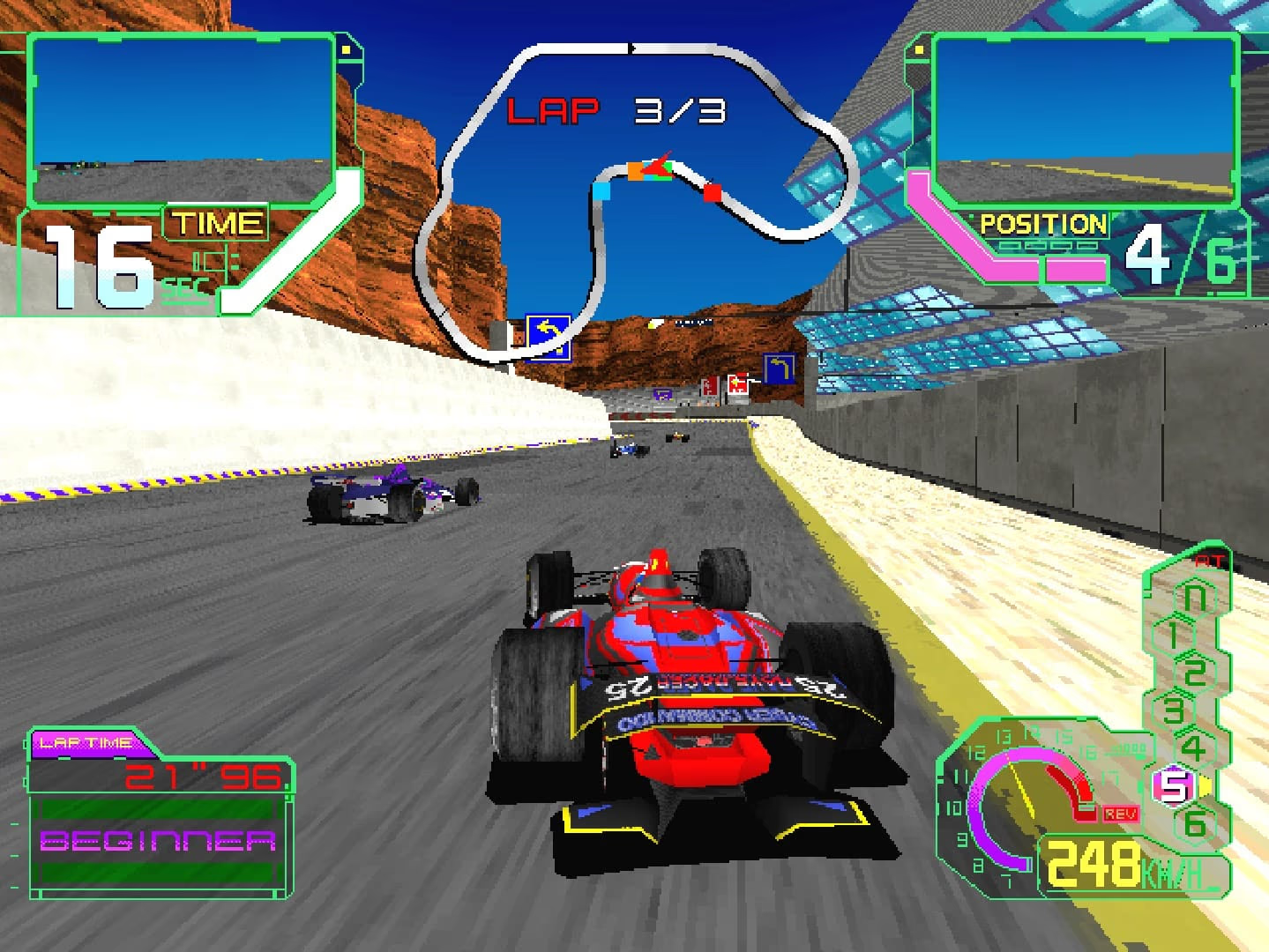
Namco's Ace Driver: Victory Lap Comes Home Through Arcade Archives, With Four Players on Newer Consoles
Hamster is releasing Namco's arcade sequel Ace Driver: Victory Lap on 22 October for Switch, PS4, Switch 2, PS5 and Xbox Series X|S, at $14.99 or $16.99, five months after the original Ace Driver.
Video Game History Foundation Opens a Photo Archive of Japanese Game Culture From 1999 to 2005
The Colin Williamson photography collection, now free in the VGHF Digital Archive, documents Tokyo Game Show, Nintendo Space World and the streets of Akihabara at the turn of the millennium.