The Hardware Saints: How a 1991 Polygon Engine Still Embarrasses Modern Graphics
The Suspicion That Will Not Go Away
If you spend enough time in retro gaming circles, you eventually hear someone say it out loud: that some games from twenty years ago look better than most things shipping today. It is the kind of statement that triggers immediate disagreement. People bring up resolution. They bring up texture filtering. They point at a recent path-traced lighting demo and ask, reasonably, whether you have actually looked at a modern game lately.
And yet the suspicion will not go away. Boot up a Resident Evil remake on the GameCube. Load a Riven save on PC. Run Crysis at maxed settings on hardware that did not exist when the game was released. There is something there, a kind of compositional confidence, a deliberate craft, that a great deal of modern AAA simply does not have. It is not that modern graphics are technically worse. It is that the older games seem to have known exactly what they were doing in a way that current releases often do not.
This piece is an attempt to take that suspicion seriously. Not as nostalgia, but as a technical question. What are these old games actually doing that their successors are not? And why, when you strip the question down to its parts, are there three completely different answers, all of which are correct?
What Graphics Actually Are
Before we can talk about the oldest game that still embarrasses modern releases, we have to be honest about what "graphics" means. The conventional answer, pixel count, polygon count, frame rate, is useful for marketing copy but tells you almost nothing about whether a game looks good. Crysis at 30fps in 2007 looked better than plenty of 60fps releases in 2024. The Wind Waker rendered at the GameCube's native 480p still looks more cohesive than upscaled 4K AAA games from last Christmas.
The honest answer is that graphics is the sum of three different things, and any given game can excel at one of them while neglecting the others.
The first is atmosphere: the composition of an image as a complete, deliberate visual statement. This is closer to cinematography or painting than to engineering. A well-framed shot of pre-rendered Riven communicates more about its world in a single still frame than hours of high-fidelity walking simulators.
The second is illustration: the cohesive expression of a style that does not depend on simulating reality. Cel-shading, sumi-e brushwork, vector art, pixel art. None of these aim at realism. All of them can outlast realism by decades because they have no real-world referent to fall behind.
The third is simulation: the brute-force rendering of physically plausible space in real time. This is the school of thought that produces benchmarks and graphics card sales. When it goes right, you get Crysis. When it goes wrong, you get a thousand brown-and-grey corridor shooters that aged like wet cardboard.
The reason there is no single oldest answer to the question is that each of these three schools has its own saint, and the saints come from different decades, different studios, and different design philosophies. To pick one is to declare what you actually mean by graphics.
School One: The Pre-Rendered Backdrops
The dirtiest secret of mid-nineties adventure gaming was that it did not have to render anything at all. Rand and Robyn Miller, working out of a small studio in Spokane, realised they could build a game out of a slideshow of impossibly detailed images, each one rendered overnight on a Mac render farm and shipped as a JPEG. The result was Myst in 1993 and Riven in 1997, and they achieved a kind of compositional photorealism that no real-time engine of the era could touch.

The trick was straightforward. A real-time renderer has to produce a new image sixty times per second, which means every shadow, every reflection, every texture has to be computed in roughly sixteen milliseconds. A pre-rendered scene has no such constraint. You can let the render farm work for six hours on a single image, applying global illumination, complex ray-traced reflections, and absurdly detailed geometry that no real-time engine of the era could touch. Then you ship the result as an image file. The console only has to decode and display it.
This sounds like cheating, and there is a longstanding argument in graphics circles about whether it counts. The answer is that the player's eye does not know how the image was produced. A painting is not lesser for being still. The question is not how the frame was made; the question is whether the frame is beautiful when it gets to the screen.
Capcom understood this better than anyone else. The Resident Evil REmake on the GameCube in 2002, Shinji Mikami's full reconstruction, not the PS1 original, took the pre-rendered idea and pushed it further than Cyan ever had. The backgrounds were pre-rendered, yes, but each pixel of each background also stored a depth value, written into a hidden buffer alongside the image data. When the 3D character model walked through the scene, the engine compared its depth against the per-pixel depth of the painting and occluded accordingly. The result is a 3D character moving believably behind painted furniture, casting dynamic shadows from light sources that were baked into the static image, and ducking behind doorframes that exist only in two dimensions. It is one of the most elegant hybrid rendering techniques in the medium's history, and almost nobody else used it.
Played in 4K via the 2015 HD edition, the Spencer Mansion still looks better than most current-generation survival horror. Twenty-four years on, it has not aged. The shadows have not moved. The light through the window has not become slightly wrong as the technology around it has matured. This is the lesson of the pre-rendered school: the artefacts that age a game are the ones that live in real-time computation. If you do not compute in real time, you do not age.
Square's pre-rendered era, Final Fantasy VII, VIII, and IX, belongs to this lineage. The character models always lagged behind the backgrounds, which is why those games look more dated than REmake despite using a similar approach. Capcom solved the integration problem; Square did not.
School Two: The Artist's Revenge
In late 2002, Nintendo released The Wind Waker and most of the audience reacted with bafflement and contempt. The cel-shaded aesthetic, chunky proportions, ink-line outlines, eyes the size of dinner plates, was read as a betrayal of the brooding realism that the Spaceworld 2000 demo had promised. Twenty-four years later, that demo's aesthetic descendants, Twilight Princess, the murkier corners of the PS2 library, look like museum pieces. Wind Waker looks like it shipped last week.
The reason is structural, and it is worth understanding in detail. A standard 3D lighting model calculates how bright each pixel should be based on the angle between the surface, the light source, and the viewer, producing a smooth gradient from light to dark. A toon shader replaces that smooth gradient with a ramp texture: a small image, typically just a few pixels wide, that quantises lighting into discrete bands. Instead of a continuous transition from lit to unlit, you get two or three flat colours, and the boundary between them is hard rather than soft.
That single change cascades through the entire visual system. Outlines are added by rendering the model's silhouette in solid black behind the cel-shaded fill, which is straightforward when you do not have to worry about realistic light scattering. Materials become flat planes of colour rather than complicated surface simulations. Shadow casting can be simplified, because the receiver only needs to know whether it is in shadow or not, there is no gradient to interpolate.
The result is a visual style that does less work and produces a more legible image. And because it does not aim at realism, it cannot fail at realism. Wind Waker has not aged because it never tried to do the thing that ages.
Clover's Okami in 2006 took the same insight in a different direction, using custom ink-bleed shaders that mimicked Edo-period scroll painting. The result is one of the most distinctive-looking games ever shipped, and one of the few PS2 titles that arguably looks better than its HD remasters in certain respects, because the original's slight grit and bloom artefacts read as part of the painterly intent rather than as compromises.
Smilebit's Jet Set Radio in 2000 deserves a special mention here, because it arguably invented the entire cel-shaded vocabulary on Dreamcast hardware that had no business being able to do it. The Dreamcast's PowerVR2 GPU was good at certain things and bad at others, and Smilebit's engine threaded the needle in a way that influenced every cel-shaded game that came after.
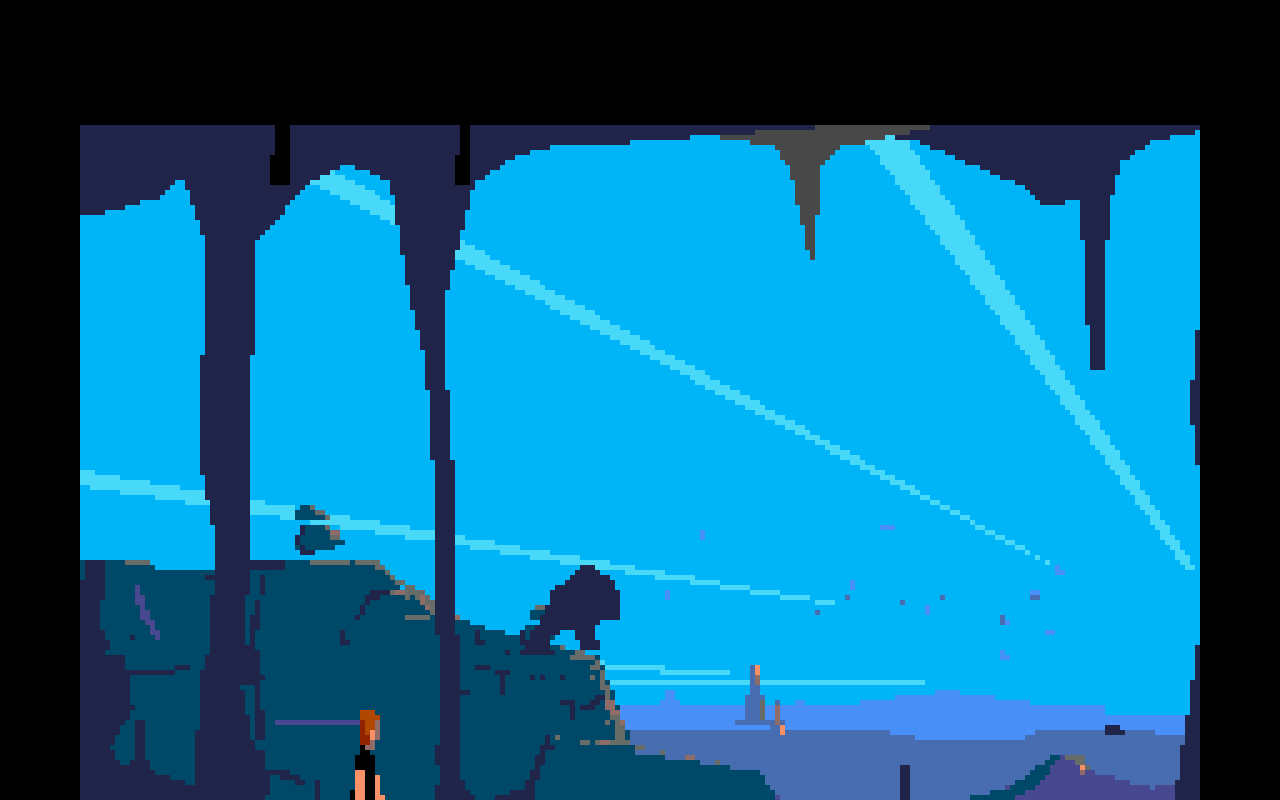
And reaching back further than any of these, there is Eric Chahi's Another World from 1991. Chahi built a custom polygon engine that drew perhaps a few hundred vector shapes per frame, with no textures, no lighting model worth speaking of, and no real-time physics. The protagonist was animated via rotoscope, traced frame by frame from Chahi's own movements. Thirty-five years later it still feels like discovering an alien text. The same rotoscoping trick is why Jordan Mechner's Prince of Persia from 1989, eight months Another World's senior, still feels uncannily alive when its contemporaries feel like clockwork.
The artist's revenge is this: realism is a horizon that recedes as you walk toward it. Style stays where you put it.
School Three: Impossible Hardware Miracles
The PlayStation 2 had 32MB of main RAM and 4MB of dedicated video memory. The GameCube had 24MB of main RAM, 16MB of slower auxiliary RAM, and 3MB embedded in its ArtX-designed Flipper GPU. On paper, these numbers should produce graphics indistinguishable from late-generation N64 cartridges. They did not.

The most quietly astonishing case is Team Silent's Silent Hill 2 in 2001 and Silent Hill 3 in 2003. Konami's Tokyo team made a series of deeply unfashionable engineering choices. Instead of spending memory on high-resolution textures, they implemented per-fragment fog, fog that was calculated per pixel rather than per vertex, producing the soft, suffocating volumetric haze that defines the series. Instead of pre-baked shadow maps, they projected stencil shadows in real time from the player's flashlight, which is why the beam picks out individual objects and casts them across the walls of the corridor in ways that feel physically correct.
But the real achievement was facial animation. Heather Mason in Silent Hill 3 emotes more credibly than the lead of any number of current AAA RPGs that cost a hundred times as much to produce. The reason is that Team Silent treated faces as performance rather than as topology benchmarks. They used relatively low-poly heads, but they animated those heads in subtle, micro-expressive ways, captured from real actors with attention to the small movements that read as life. Modern AAA games have far more polygons in their character heads and far less life in their faces, because they spend their animation budget on lip-sync accuracy and pore detail rather than on whether the character looks like they are thinking.
Kojima Productions' Metal Gear Solid 2 in 2001 extracted volumetric rain, refractive water, and arguably the era's best material shaders from the same PS2 hardware. Team Ico's Shadow of the Colossus in 2005 shipped with a custom motion blur and pseudo-HDR pipeline so demanding that the framerate frequently buckled, and so beautiful that nobody minded. ICO in 2001, the team's debut, simply pushed the bloom to extreme levels and let backlit silhouettes do everything its restrained dialogue could not.
What unites all of these games is that their hardware constraints forced their designers to choose. You could not have everything on a PS2. You had to pick what mattered. The games that picked best are the ones that still look extraordinary, because their choices were deliberate, and the things they chose were the things that age well, atmosphere, mood, light, performance, rather than the things that age badly, like polygon count and texture resolution.
Modern engines do not require choice. This is, on the evidence, a problem.
School Four (Or Possibly The Last One Standing): Crysis
Crytek's engineers in Frankfurt shipped a PC game in November 2007 designed for hardware that did not yet exist. Crysis ran on CryEngine 2, a forward-rendering pipeline, meaning it calculated lighting in a single pass during the main render rather than splitting it into a separate geometry-and-lighting stage as modern deferred renderers do, and it threw an extraordinary amount of technology at the problem of rendering a tropical island.
Screen-space ambient occlusion, which Crysis effectively introduced to consumer gaming, approximated soft shadows in the crevices and corners of objects by sampling the depth buffer around each pixel and darkening areas where nearby geometry would have occluded ambient light. It was an approximation, but a convincing one, and it added a sense of weight and groundedness to scenes that had been missing from real-time graphics until that point. Parallax occlusion mapping displaced texture coordinates based on a height map, making flat polygons appear to have actual three-dimensional surface detail without adding any geometry. Object-based motion blur tracked the velocity of every moving object and smeared its pixels accordingly, producing a sense of inertia that most modern games still do not bother with.
The most absurd achievement was the vegetation. Crysis's tropical island simulated foliage to a degree that no engine since has matched. Every palm tree could be chopped down with sustained machine-gun fire. Leaves responded to wind and to the player's movement through them. Bullets passed through fronds with appropriate physical effects. Light filtered through the canopy was calculated as approximate global illumination in real time, at a moment when "global illumination" was a term that most studios used about overnight offline renders, not interactive game graphics.
"Can it run Crysis" was a joke that stopped being a joke around 2014, when it became apparent that the answer was: no, actually, not really, not at the settings Crytek intended. The game ran badly on its launch hardware because it was not aimed at its launch hardware. It was aimed at the future. The future, on the evidence of every AAA release since, has politely declined to arrive.
This is not entirely Crytek's fault. Modern AAA development concluded that this kind of ambition is commercially insane, and they were probably right. Crysis is the last major game whose graphical brief was "as much as is technically possible, with no concession to what is reasonable." Everything since has been an exercise in optimisation toward console parity, with deferred renderers, temporal upscalers, and motion-vector hacks doing the heavy lifting that honest geometry and honest lighting used to do.
The result is that an eighteen-year-old PC release still embarrasses a great deal of 2025 output in vegetation density, lighting-model honesty, and environmental destructibility. Not because Crytek were geniuses, although they were, but because Crytek were willing to ship something that did not work on the hardware most people owned, and no studio is willing to do that anymore.
Why Modern AAA Often Looks Worse Than It Should
It is worth saying clearly: the issue is not that modern hardware is incapable of producing better graphics than these old games. It plainly is. A current GPU can render scenes that no 2007 hardware could approach.
The issue is structural. Modern AAA development is an exercise in risk management. Games cost hundreds of millions of dollars to produce, which means they have to sell to as wide an audience as possible, which means they have to run on the lowest common denominator of available hardware. The lowest common denominator is a base PlayStation 5 or Xbox Series S, which means deferred rendering, aggressive LOD systems, temporal upscalers that smear detail across frames, and a thousand other small compromises baked into the pipeline before any artist sets to work.
Each of these techniques is individually defensible. Deferred rendering is more efficient for scenes with many light sources. Temporal upscaling reclaims performance that can be spent elsewhere. LOD systems prevent the game from melting when the camera looks at distant geometry. The issue is the compound effect, every shortcut introduces its own visual artefacts, and the artefacts pile up until the final image looks fundamentally less coherent than a forward-rendered Crysis at its intended settings, or a pre-rendered REmake background, or a cel-shaded Wind Waker frame that was never trying to be photorealistic in the first place.
The hardware saints did not face these constraints because their budgets were smaller, their teams were tighter, their target audiences were narrower, and their tools were less abstracted. They had to choose what mattered, and they got to choose without a marketing department weighing in. Modern AAA has all the technical capability in the world and almost none of the institutional freedom to use it well.
Three Answers, Three Schools
So which is the oldest game whose graphics still embarrass modern releases? There is no single answer because the question is malformed. There are three, and which one you pick reveals what you believe graphics are actually for.
If you believe graphics are atmosphere, the deliberate composition of a beautiful image, sustained over a play session, the answer is Resident Evil REmake from 2002, with Riven from 1997 as its more elderly ancestor.
If you believe graphics are illustration, the cohesive expression of a stylistic vision unmoored from hardware, the answer is The Wind Waker from 2002, with Another World from 1991 as its prophet.
If you believe graphics are simulation, the brute-force rendering of a physically plausible world in real time, the answer is Crysis from 2007, and there is no second place.
What unites all three saints is a refusal to compromise that the contemporary AAA pipeline structurally forbids. Each was made by a team that prioritised craft over scope. Each was punished, at least initially, by commerce or by criticism for doing so. Each has outlasted everything its successors have shipped.
What This Actually Means
The lesson of the hardware saints is not that we should go back. It is not even that modern games are bad, most of them are not, and the best of them are very good indeed. The lesson is that the things that make a game look beautiful twenty years later have very little to do with the things that drive marketing demos.
Polygon count does not survive. Texture resolution does not survive. Cutting-edge real-time lighting techniques rarely survive, because they get superseded within a decade and then look obviously dated. What survives is composition, restraint, the discipline of an art director who knew exactly what they wanted the screen to look like, and the willingness to ship something that does that one thing without compromise.
The pre-rendered backgrounds of Riven and REmake survive because they were composed like paintings. The cel-shading of Wind Waker and the brushwork of Okami survive because their styles did not depend on hardware. The hardware miracles of Silent Hill 3 and Shadow of the Colossus survive because their designers chose atmosphere over polygon counts. Crysis survives because Crytek refused to scale back, even when refusing to scale back was commercially indefensible.
Modern graphics are not the problem. Modern graphics budgets are the problem, budgets in the managerial sense, the sense that requires every visual decision to be defended against a spreadsheet of cross-platform performance targets. The hardware saints knew that twenty years ago. The rest of us are slowly remembering.